A Heart Cry for Revival: Day One

January 1: Isaiah 6:1-13

The Backward View

Please use this as an aid to your daily prayers. Do not use it as a substitute for prayer, and do not let it become a distraction from prayer. It is provided as a guide to help prepare you for your prayer time.

The Author

         Isaiah 6 is usually referred to as Isaiah’s call. The main question about this call is where it is placed. There have been five chapters of prophecy confronting Judah with its sinful condition and pleading with them to repent. Now Isaiah records his call, which forms the basis of his ministry as a prophet. This is no mistake. The first five chapters make the contrast between the condition of God’s people and the character of their God all the more striking. It is a moving account of Isaiah’s encounter with the living God.

      It is important to note the context of this call. The account of Isaiah’s call refers to Uzziah’s death, providing a marker for dating the call of Isaiah at approximately around 740 BC. We find accounts of Uzziah’s (or Azariah’s) reign in 2 Kings 14:21-22, 15:1-3 and 2 Chronicles 26:1-23. His reign was one of prosperity both in terms of military conquest and agricultural development. However, at the height of his rule, his prosperity became his downfall. It is recorded:

      “But when he was strong his heart was lifted up, to his destruction, for he transgressed against the LORD his God by entering the temple of the LORD to burn incense on the altar of incense.” (2 Chronicles 26:16, NKJV)

      Isaiah had observed the consequences of unauthorized access to God’s holy space and profaned attempts to serve Him in pride and vanity. Uzziah paid dearly for his sin. He remained a leper for the rest of his life, cut off from the house of the Lord and living in seclusion. It seems that Jotham, his son, reigned in his place. The son “did what was right in the sight of the LORD” (2 Chronicles 27:2) but that did not affect the attitude of the people, for “still the people acted corruptly” (2 Chronicles 27:2). It seems that the times of prosperity had the effect of lulling the people into selfish pride and idolatry.

APPLICATION

God works in the circumstances of life, preparing us to seek Him and to receive a fresh vision of His nature and glory. We can readily identify with the times of Isaiah. We have experienced unprecedented prosperity, which has had the effect of lulling people into complacency, compromise, selfish pride and idolatry (the sin of replacing God with anything else as our ultimate authority). Many of us long to gain a fresh vision of the glory of God. We are longing for God to bring times of refreshing upon us.

Do you think that the timing of Isaiah’s call may have been conditioned by his circumstances?

What circumstances might God be using in your life right now to prepare you to gain a greater vision of His character and holiness?

      Prosperity can be a good thing when we receive God’s blessings with humility and gratitude, but when we become cocky and self-sufficient, thinking that we have these blessings because of our efforts, we are teetering on destruction (“Pride goes before destruction and a haughty spirit before a fall”—Proverbs 16:18). 

Have you fallen prey to taking God’s blessings for granted?

      Adversity can serve as a megaphone in our lives.

 “Pain insists upon being attended to. God whispers to us in our pleasures, speaks in our consciences, but shouts in our pains.It is his megaphone to rouse a deaf world” (C.S. Lewis). 

Are there nagging problems, an insurmountable obstacle, unmet needs, or some other difficult, unrelenting situation you are facing that God may be using to get your attention?

      A spiritual void demands to be filled. You may be sensing that you are just going through the motions, living on autopilot, and getting nowhere. 

Is there a nagging sense of spiritual dullness or a deep longing for more fulfillment in life?

      Distraction can often sidetrack us from what is important in life. As Luke records Jesus’ words, we are “choked with cares, riches, and pleasures of life” and so our lives become unfruitful (Luke 8:14). As the distractions of life wear on us, we become weary and restless. We know there has to be more to life, but we don’t know how to stop the constant barrage of activities that keep coming. 

Is God trying to get your attention through the feeling of being overwhelmed?

      Whatever the circumstances in your life, now is the time to ask God what He is using and how He is working to get your attention refocused on His glory, His holiness, His character. His will, His work, His way should be our greatest desire, as we are taught to pray “Hallowed be Thy name, Thy kingdom come, Thy will be done, on earth as it is in heaven. Amen.”

PRAYER

Dear Father,

I am thankful that my life and my circumstances are in Your control. You constantly watch over me. You are my shield, my fortress, and my God in Whom I place my complete trust. When I recall the ways that You have worked to deliver me and help me in the past, I gain a renewed confidence in your providential care.

Father, I acknowledge Your Lordship in my life. I want to understand how You are leading and teaching me in my present circumstances. I want to hear Your voice and know what You want me to know, say and do. My heart cries out to You in this present moment. I long to draw near in full assurance of faith. I seek You with my whole heart. You have promised to reveal Yourself to those who earnestly seek You with their whole heart.

God of all comfort, please bring comfort to me in my time of trouble. There is no circumstance beyond your power, no person beyond your love. I ask that I would know your comforting presence. Use me, Lord, to comfort others with the comfort I have received from you. May your peace overflow in my life and bless those around me. 

NOTE: This prayer is offered as a guide. Offer these words, add to them, or substitute your own. Seek to develop a deeper awareness of how God is working in your present circumstances.

Posted in A Heart Cry for Revival | Tagged , , , , | Leave a comment

A Heart Cry for Revival

Introduction

What is the goal of this emphasis? What are we trying to accomplish?

The desire to see a great movement of God’s Spirit upon His people in response to the prayers of His people and a greater vision of God’s glory as we seek Him in His Word and in prayer is our aim. We know that this will not happen unless there is a concerted effort by His people to seek Him.

That is why we are calling these 60 days (January 1, 2024 through February 29, 2024) of praying for revival as a HEART CRY for REVIVAL. We believe that God responds to the earnest seeker.

“and he went out to meet Asa and said to him, “Hear me, Asa, and all Judah and Benjamin: The LORD is with you while you are with him. If you seek him, he will be found by you, but if you forsake him, he will forsake you.”

(2Ch 15:2, ESV)

““And you, Solomon my son, know the God of your father and serve him with a whole heart and with a willing mind, for the LORD searches all hearts and understands every plan and thought. If you seek him, he will be found by you, but if you forsake him, he will cast you off forever.”

(1Ch 28:9, ESV)

““Seek the LORD while he may be found; call upon him while he is near; let the wicked forsake his way, and the unrighteous man his thoughts; let him return to the LORD, that he may have compassion on him, and to our God, for he will abundantly pardon.”

(Isa 55:6-7, ESV)

Early copies of the book were sent out with the thought that if the leaders of the church could see that in spiritual work everything depends upon prayer, and that God himself helps those who wait on Him, it could truly be a day of hope for our church. It was also intended for all believers who longed for a life of complete separation to the Lord. For all who desired to pray more and pray more effectively, it pointed to the glory of God in the personal place of prayer and the way that power can rest upon the soul.

 Murray, A. (2002). Living a prayerful life. Bethany House. Preface.

We want you to pray, and to find joy in prayer. But more than that we want you to gain a deeper appreciation and affection for the object of our prayers, God Himself. These passages have been chosen for that very reason. Isaiah recorded his vision of God’s splendor, holiness and glory for us to gain a deeper appreciation for the God we serve. Daniel opens his prayer by acknowledging the Lord who is great and awesome, who keeps His covenant and mercy. Nehemiah begins his prayer essentially the same way as Daniel with very similar wording. Jehoshaphat begins his prayer by recognizing who God is and by recounting the promise God made to Solomon at the inauguration and dedication of the Temple. These are powerful prayers because the one praying knew the One he was praying to.

We also want to focus on ourselves, specifically on our sins and the sins of our forefathers and culture. The decision to be completely honest and open before the Lord, to confess the failures of our fathers and of ourselves as these prayers model, will yield the fruit of forgiveness and blessing. God will not bless unrighteousness. He will not bless our sin, nor will He bless us in our sin. We should note that the sins of the fathers have generational effects upon the children and their children (see Exod. 20:4-6). These prayers acknowledge this spiritual truth.

“Submit yourselves therefore to God. Resist the devil, and he will flee from you. Draw near to God, and he will draw near to you. Cleanse your hands, you sinners, and purify your hearts, you double-minded. Be wretched and mourn and weep. Let your laughter be turned to mourning and your joy to gloom. Humble yourselves before the Lord, and he will exalt you.”

(Jas 4:7-10, ESV)

We want you to be open to how God wants you to be involved in His Work. God has not called us to complacency, comfort, or self-fulfillment. He has chosen us to do His Will. As you are praying, ask yourself afresh how God would be pleased to work through you to reach a lost world. “Here am I, send me!” This is the response, I believe, that God would be most pleased to hear.

Posted in A Heart Cry for Revival | Tagged , , , , | Leave a comment

Another Great Disappointment

What do you think of when you hear the word “fellowship”?


    Do you think of a group of people bound by a common purpose (fellowship of the ring, Fellowship of Christian Athletes, etc.)?
    Do you think of a fellowship meal, such as one served on special occasions at church?
    Do you think of light-hearted banter and laughter, as when a family reunion is held?
    What favorite memory comes to mind when you hear the word “fellowship”?

In the Bible fellowship is an important concept.

Psalms 55:14 (WEB) 14We took sweet fellowship together. We walked in God’s house with company.

Acts 2:42 (WEB) 42They continued steadfastly in the apostles’ teaching and fellowship, in the breaking of bread, and prayer.

1 Corinthians 1:9 (WEB) 9God is faithful, through whom you were called into the fellowship of his Son, Jesus Christ, our Lord.

2 Corinthians 8:3-4 (WEB) 3For according to their power, I testify, yes and beyond their power, they gave of their own accord, 4begging us with much entreaty to receive this grace and the fellowship in the service to the saints.

2 Corinthians 13:14 (WEB) 14The grace of the Lord Jesus Christ, the love of God, and the fellowship of the Holy Spirit, be with you all. Amen.

Philemon 6 (WEB) 6that the fellowship of your faith may become effective, in the knowledge of every good thing which is in us in Christ Jesus.

1 John 1:7 (WEB) 7But if we walk in the light, as he is in the light, we have fellowship with one another, and the blood of Jesus Christ, his Son, cleanses us from all sin.


Fellowship is one of the key practices that the early church was devoted to pursuing (see Acts 2:42 above). Throughout the book of Acts we see the church gathered. The Greek word “ekklesia” literally means “assembly.” The church is the “assembled” or “gathered” group of believers. The church is more than family or friends meeting for food or friendship and conversation. It is even more than a Bible study. It is the gathering of the body of Christ to study the Word, to practice koinonia (where we obey the reciprocal commands: loving one another, caring for one another, forgiving one another, serving one another, etc.), to celebrate and worship together, observing the sacraments, and to pray together. These activities are NOT optional, NOT trivial, NOT private and NOT to be neglected (see Hebrews 10:23-25).

The Reality

  • Almost 6 in 10 Americans see valid alternatives to worshiping in a church with other believers. And more than a third say worship services should be entertaining if churches want to be effective.
  • Fifty-eight percent of Americans agree that worshiping alone or with one’s family is a valid replacement for regularly attending church. Thirty percent disagree. Twelve percent are not sure.
  • “Church attendance has long been a measure of religious and devotion,” Scott McConnell, head of LifeWay Research, said. “Today, less than half of religious service attendees see regularly gathering for worship with other believers at church as essential.”

The statistics reveal what pastors have been observing for some time now. Church attendance has not only been decreasing, but has diminished in its appeal. More people see church attendance as unimportant. More people allow other activities to override church attendance. The world system has certainly conspired in this, planning events and activities at times and on days normally associated with religious worship. However, the choice between worship with the gathered church and involvement in other activities is a matter of priorities. What is more (most) important?

It all comes down to delight. When I was in high school, I was heavily involved in my church and its activities. I was a youth leader in the church, but I was constantly drawn to to the church and to its various members by the encouragement, laughter and comraderie we shared. We were constantly seeking ways to be involved in each other’s lives. I eagerly anticipated opportunities to be involved in the services, programs and activities of the church. I wanted to invite people to my church and to share Jesus with others. Those were exciting days for me. I found delight in this.

When we delight in the things of the Lord, His Word, His work, and His people, we will make time for “fellowship.” When the church practices Biblical fellowship, people are aware of it, amazed by it and attracted to it. We must STOP “forsaking the assembling of ourselves together!” We must be DEVOTED to fellowship. Otherwise, our spiritual lives are impoverished, our testimony is diluted, and our impact is diminished. We fail, not because we are belligerent, but because we are simply indifferent.

Posted in Musings from the Manse | Leave a comment

A Great Disappointment

man old depressed headache

Photo by Gerd Altmann on Pexels.com

Today, as I prepare to preach another sermon and lead another Bible study, I feel a burden that I do not usually bear, although I probably should, given what I intuitively know.

I am beginning to realize what I have sensed for a while, that the Word I have spent a lifetime (43 1/2 years now) sharing is a Word that has less reverence, respect, and authority among people generally and even among the people I serve specifically.

A new survey has come out from Lifeway Research, indicating a trend that is continuing almost unabated and one that pastors like myself have been feeling in our own ministries all along. It points out one reason pastors no longer command respect: people no longer respect the Book pastors represent.


Research Results

Researchers found Americans are split on their views of the Bible. More Americans believe the Bible is completely accurate, however, a growing number say the Bible is not literally true.

In 2018, half of Americans say the Bible is 100 percent accurate in all that it teaches. That’s up from 47 percent in 2016 and 43 percent in 2014.

Fewer than half (47 percent) of Americans agree the Bible contains helpful accounts of ancient myths but isn’t literally true. Forty-three percent disagree. In 2016, 44 percent agreed the Bible isn’t literally true, and 41 percent said the same in 2014.

“The last writing included in the Christian Bible was completed nearly 2,000 years ago,” McConnell said. “Yet Americans’ beliefs around this book are shifting more than most other theological beliefs.” — Scott McConnell, Executive Director of LifeWay Research


As goes our attitude toward the Bible, so goes our spiritual vigor.

That’s why the psalmist in Psalm 119 focuses so much attention on his attitude and affection for the Word. He realizes that this Word is directly linked to the Author. The more he knows the Word, the more he knows the Author. The more he respects and cherishes the Word, the more he does it’s Author. The Word has become “his delight.”

When I see people uninterested and disengaged when hearing the Word read and explained, I long for a day when people, who had pleaded for the Law to be read, stood for hours to hear it read and explained (Nehemiah 8). I long for experiences where people come to me and beg to have a Bible study or class. I long for the excitement I used to feel when I entered a Bible conference or revival services, where people were waiting with an excitement to hear the Word that was electrifying. Those were the days….

As my delight for the Word has been increasing, the delight of many has been decreasing. As it decreases, it brings spiritual drought. We need an authoritative Word, a “Thus says the Lord,” if we are to progress in our spiritual lives. It’s one thing to “feel” spiritual and another entirely to “be” spiritual. If we are to “be” spiritual, we must have a solid foundation on which to build. In the past, that concrete foundation was the Bible. Today, it is constructed on the sands of “I think so” or “that’s just how I feel about it.”

I would encourage any serious-minded seeker of spiritual life to go back to the longest chapter in the Bible (Psalm 119) and spend some time with a seeker who shares the same goal. You will see that his need for spiritual guidance and information, his need for an authoritative Word, and his need for encouragement and comfort came from the Bible (the law of the Lord).

To the degree that we have failed to delight in the Word, we have failed to pursue the spiritual life we desire and God designed.

Psalms 1:1-3 (WEB)

1Blessed is the man who doesn’t walk in the counsel of the wicked,

nor stand in the way of sinners,

nor sit in the seat of scoffers;

2but his delight is in Yahweh’s law.

On his law he meditates day and night.

3He will be like a tree planted by the streams of water,

that brings forth its fruit in its season,

whose leaf also does not wither.

Whatever he does shall prosper.

Posted in Musings from the Manse | Leave a comment

Why Delight Is So Important?

Genesis 3:6 (WEB) When the woman saw that the tree was good for food, and that it was a delight to the eyes, and that the tree was to be desired to make one wise, she took of its fruit, and ate; and she gave some to her husband with her, and he ate.

Psalms 119:47 (WEB) I will delight myself in your commandments, because I love them.

Matthew 6:21 (WEB) for where your treasure is, there your heart will be also.

When I was able to eat sweets, my favorite dessert (served for my birthday) was strawberry cream cheese pie. You might say (with some understatement) that it was my delight! My wife would make one pie just for me and one for the rest of the family. This could be one reason why I am now too sweet and must refrain from sweets altogether. My taste buds were so delighted by this dessert that I could consume the whole pie in one sitting.

When something brings delight, it attracts our attention (as when the woman saw the fruit was a delight to the eyes), elicits our affection (as the psalmist expresses in 119), and captures our focus (as Jesus explains about treasure).

My delight drives my desire. When something delights me, I want more. Sometimes, my delight is insatiable, so strong is the craving. Delight is not the problem. Desire is not the problem. Craving is not the problem. What brings delight, what is desired, what is craved, may very well be! We need to learn to delight, desire and crave what is best for us, not what brings immediate gratification, but eventual destruction.

The verses listed below from Psalm 119 are the eight other places in the psalm where the author mentions delight. Obviously, the thing that had attracted his attention, elicited his affection, and captured his focus was the Word of God. It has become his DELIGHT. Because of this delight, he cannot forget God’s words. They have become his counselors, directing his path, even if others are unaffected by God’s Word. In God’s Word the author has also found comfort and assurance in affliction and troubles. Because of this delight, the Word of God has a special place in his life, a special function for his life, the special focus of his life.

Some may say that they find the Word of God boring. Others may reply that the Word of God has become more important to the author than God Himself. Still others may think that the author has overstated his case concerning the Word. But I disagree.

When my wife and I were preparing to marry, we had to spend the last three months apart. She was in Florida, making final preparations for the wedding, and I was in Arkansas, serving as a youth director for my church. This happened in the days before internet, email, texting, and cell phones. Long-distance calls were expensive and prohibitive to the average consumer. Party lines were a given (and other neighbors could listen in on private conversations). However, we were committed to communicating with each other through letters, writing at least every other day (as I recall), and talking on the telephone once a week (all I could afford).

I can honestly say that those letters were never boring to me, no matter how inconsequential the details or generic the descriptions. My delight was in knowing that my beloved cared about me and was communicating with me. Sometimes, because the postal system had certain idiosyncrasies inexplicable to the common man, letters sent might not arrive as planned or scheduled. I might have to go several days without receiving a single letter. Then, I might receive several in a single day. The days when no letter was received caused great disappointment. I would wonder if she was still thinking about me, still caring for me. Young love can be very insecure love, if not fed with constant attention. But when several arrived the same day, I was thrilled. There was never enough time to catch up during the brief weekly phone conversations. Letters could fill in the details and embellish the responses.

I can also say that I did not idolize those letters. They weren’t what was most important to me. My beloved was the object of my delight, but those letters brought delight because they came from her. They were important to me because she was important to me. The letters from unknown senders would not have the same impact. They would be tossed aside, while hers were opened immediately.

If we consider the Word of God in this way, as His love letter to us, expressing his care and his concern, we would, no doubt, find His Word as delightful as the psalmist did. It would hold a special place in our lives, gathering our attention, garnering our affection, and gaining our focus. It is not the Word that we are in love with; it is the Author. We love the Word, because we love the Author, and it is a Word from Him that we want, we need, and we delight in receiving.

It is because we do not delight in the Word, that we fail to appreciate it and pursue it. But if we delight in the Author, we should delight in His Word. And delight is the difference between drudgery and desire.

Psalms 119:16 (WEB)

16I will delight myself in your statutes.

I will not forget your word.

Psalms 119:24 (WEB)

24Indeed your statutes are my delight,

and my counselors.

Psalms 119:35 (WEB)

35Direct me in the path of your commandments,

for I delight in them.

Psalms 119:70 (WEB)

70Their heart is as callous as the fat,

but I delight in your law.

Psalms 119:77 (WEB)

77Let your tender mercies come to me, that I may live;

for your law is my delight.

Psalms 119:92 (WEB)

92Unless your law had been my delight,

I would have perished in my affliction.

Psalms 119:143 (WEB)

143Trouble and anguish have taken hold of me.

Your commandments are my delight.

Psalms 119:174 (WEB)

174I have longed for your salvation, Yahweh.

Your law is my delight.

Posted in Musings from the Manse | 1 Comment

My DELIGHT

What has captured your undivided attention…ignited your passion…enlisted your energy…brought renewed interest and excitement…and given a new sense of purpose to your life?

What brings delight to your life? What thrills and excites you?

Psalm 40:8
I delight to do Your will, O my God;
Your Law is within my heart.”

Psalm 1:2
But his delight is in the law of the Lord,
And in His law he meditates day and night.

Definition of delight (according to Merriam Webster’s Dictionary)
1. a high degree of gratification or pleasure : JOY; children squealing in delight; also : extreme satisfaction

2. something that gives great pleasure; her performance was a delight

3. archaic : the power of affording pleasure; of more delight than hawks or horses be— Shakespeare

Commenting on the Hebrew word translated “delight”, the International Standard Bible Encyclopedia has this:

The element of joy, of delight in God and His law and will, in the Hebrew religion is noteworthy as being something which we are apt to fall beneath even in the clearer light of Christianity.
W. L. Walker

Recently, I have been conducting a more intensive and extensive study of Psalm 119, the longest chapter in the Bible. I decided to do this because, in the past, I have memorized several key Bible verses in this psalm that have helped me, and because, as the Director of Light of Life Ministry, I lead a ministry devoted to and focused on helping believers gain a deeper understanding of God’s Word.

It is a remarkable psalm for several reasons:

• The longest chapter in the Bible is devoted to a single purpose: to extol and to call attention to the Word of God
• It is a beautiful and intricate acrostic poem: each stanza of 8 verses begins with a letter of the Hebrew alphabet (and since there are 22 letters in the alphabet, there are 22 stanzas) and each verse in a particular stanza begins with the letter of that stanza
• It is 176 verses long because 22 stanzas times 8 verses each stanza equals 176
• It utilizes at least 8 different words to describe the Word of God (which I will discuss in another post)
• It is repetitive in the use of words and themes without seeming so

One repeated theme is that of “delight in God’s Word.” I note the following (emphasis mine):

• Psalms 119:14 (WEB) I have rejoiced in the way of your testimonies, as much as in all riches.
• Psalms 119:16 (WEB) I will delight myself in your statutes. I will not forget your word.
• Psalms 119:20 (WEB) My soul is consumed with longing for your ordinances at all times.
• Psalms 119:24 (WEB) Indeed your statutes are my delight, and my counselors.
• Psalms 119:35 (WEB) Direct me in the path of your commandments, for I delight in them.
• Psalms 119:47 (WEB) I will delight myself in your commandments, because I love them.
• Psalms 119:54 (WEB) Your statutes have been my songs, in the house where I live.
• Psalms 119:70 (WEB) Their heart is as callous as the fat, but I delight in your law.
• Psalms 119:72 (WEB) The law of your mouth is better to me than thousands of pieces of gold and silver.
• Psalms 119:77 (WEB) Let your tender mercies come to me, that I may live; for your law is my delight.
• Psalms 119:92 (WEB) Unless your law had been my delight, I would have perished in my affliction.
• Psalms 119:97 (WEB) How I love your law! It is my meditation all day.
• Psalms 119:111 (WEB) I have taken your testimonies as a heritage forever, for they are the joy of my heart.
• Psalms 119:113 (WEB) I hate double-minded men, but I love your law.
• Psalms 119:119 (WEB) You put away all the wicked of the earth like dross. Therefore I love your testimonies.
• Psalms 119:127 (WEB) Therefore I love your commandments more than gold, yes, more than pure gold.
• Psalms 119:129 (WEB) Your testimonies are wonderful, therefore my soul keeps them.
• Psalms 119:143 (WEB) Trouble and anguish have taken hold of me. Your commandments are my delight.
• Psalms 119:159 (WEB) Consider how I love your precepts. Revive me, Yahweh, according to your loving kindness.
• Psalms 119:162-163 (WEB) I rejoice at your word, as one who finds great spoil. I hate and abhor falsehood. I love your law.
• Psalms 119:167 (WEB) My soul has observed your testimonies. I love them exceedingly.
• Psalms 119:174 (WEB) I have longed for your salvation, Yahweh. Your law is my delight.

If you have gotten this far, you may be thinking that my references were overkill. I just thought that it would be important to note how often the psalmist repeats the sentiment of love, rejoicing and delight in the Word of God. Obviously, it is a great source of joy, a subject about which he has great passion, and the focus of his life—his DELIGHT!

Is this book, the Bible, your delight? Is it the source of your wisdom, strength and help? Is it your comfort in times of trouble? Is it your hope in times of discouragement? Is it your joy in times of sorrow? Is it exactly what you need, whatever you are facing?

I want to encourage you to consider the attitude of the writer of Psalm 119 and adopt that attitude. You will find that your love and delight in God’s Word will translate into significant benefits in your life (which I will discuss in a later post).

Stay in the Word and it will stay in you and be your stay in life.

Posted in Musings from the Manse | Leave a comment

Calling Sin a Mistake Is a Mistake

mistake

noun

1. an error in action, calculation, opinion, or judgment caused by poor reasoning, carelessness, insufficient knowledge, etc.

2. a misunderstanding or misconception.


sin

noun

1. transgression of divine law:

the sin of Adam.

2. any act regarded as such a transgression, especially a willful or deliberate violation of some religious or moral principle.

3. any reprehensible or regrettable action, behavior, lapse, etc.; great fault or offense:

It’s a sin to waste time.


Recently, I read the apology of the mayor of Nashville, TN about the affair she carried on with a member of her security detail where she said that she had made “a mistake.” After all, we are all human and all prone to make mistakes. I have made mistakes in actions. I have made decisions that I thought were wise and beneficial, only to discover that those decisions were poor ones because I didn’t possess all of the information I needed. I confess that I am not as proficient as my math teacher sister and have often made mistakes in calculations. My opinions are not infallible, so I have made mistakes there. Poor reasoning, carelessness, and insufficient knowledge as well as misunderstanding and misconception have all played a part in the many mistakes I have made during my 62 years of life. I certainly regret these mistakes and the consequences which have followed them.

However, when I hear people describe deliberate, premeditated, and serious breaches of morality and ethics as “mistakes” (as the mayor did), I bristle because it seems that they use it to minimize or excuse these breaches.

1 John 3:4 (WEB) Everyone who sins also commits lawlessness. Sin is lawlessness.

I think it is a mistake to call sin a mistake, because it seems that we are seeking to deflect the severity of our trespass and alleviate our guilt. We downplay the hurt and the consequences of our sin. We seek to excuse our wrongdoing by giving the impression that we didn’t know what we were doing, or that we didn’t realize the consequences. It’s not really our fault or, at least, not fully our fault. If you knew all of the extenuating circumstances, surely you would understand why this happened. But trying to blunt the reality of our sin and its consequences only keeps us from fully embracing the responsibility for our sin, deeply feeling the remorse for its hurt to us and others, and truly repenting of our sin and seeking to turn away from it. It also minimizes the price that has been paid for sin (Hebrews 9:26; Isaiah 53:10; 2 Corinthians 5:21; Romans 8:3).

Embrace in one act the two truths–thine own sin, and God’s infinite mercy in Jesus Christ. ~ Alexander MacLaren

We have a strange illusion that mere time cancels sin. But mere time does nothing either to the fact or to the guilt of a sin. ~ C.S. Lewis

Let us stop the progress of sin in our soul at the first stage, for the farther it goes the faster it will increase. ~ Thomas Fuller

Posted in Musings from the Manse | 3 Comments

Living by the Book

The Opposite of Going beyond What Is Written!

I have signed the Nashville statement, because I believe it accurately and succinctly states what I believe the Bible teaches about human sexuality.  Some have thought that because it has been named the “Nashville” statement, it somehow reflects what Nashville believes. It is not really about Nashville at all (except for the fact that those who constructed the statement were meeting in Nashville). It is about historic Christianity: what the Christian church has always taught and believed about these issues.

It is no secret that many within and without the church do not hold to these historic orthodox views on human sexuality; nor do they hold to the historic Christian faith in many other areas as well.  For someone to state them boldly and hold to them strongly makes these others uncomfortable. So, in response, a group of three neighbors came up with another statement which they feel more accurately represents what Nashville citizens believe.

The new statement — called the “Accurate Nashville Statement” — says “god loves you just the way you are” no matter if you identify as LGBT or not.

Of course, this doesn’t come from those with “theology degrees and white men.”  That should seal the deal.  Make a statement.  Call the opposition names.  Game over.  And charges of abuse and bigotry on the part of the learned theologians follow.  This further solidifies the charges.

The group further counters: “Let’s be clear: Any time a few humans make another feel miserable in their own skin because they think their small worldview has the monopoly on who/what God is – thats abusive and horrific behavior.”

SO, let me be clear. When people seek to establish their beliefs based on what they think, or what others will think about them, THEY HAVE GONE BEYOND WHAT IS WRITTEN!

When religious ideas and views become the established view concerning these issues because they are the most popular, WE HAVE GONE BEYOND WHAT IS WRITTEN!

When we refuse to speak out against SIN because it makes people feel uncomfortable, WE HAVE GONE BEYOND WHAT IS WRITTEN!

When we in our pride decide to speak for God with no more authority than “this is how I feel about it,” WE HAVE GONE BEYOND WHAT IS WRITTEN!

Let’s be clearer still: Christianity is a whole system, a whole body of Truth. We cannot simply take and believe what want and then reject or neglect the rest. This system of Truth is based upon what God has revealed about Himself, ourselves, our world and our destiny in the Bible. The theologians who gathered and presented the Nashville Statement, found here, worked meticulously to state with simplicity and clarity what the Bible teaches about human sexuality. It wasn’t about how they felt, or what they wanted to believe, or how people would feel about their work. It was about what God says to us concerning our sexuality.

So sure that the issue is settled in favor of the “Accurate Nashville Statement,” some are calling the Nashville Statement “the religious right’s death rattle.” Others say that when the Bible “contradicts” what “science and nature” reveals, another interpretation of the Bible must be sought. So, we must now make the Bible say what we want it to, no matter how distorted the outcome.

My response must be similar to that of the Apostles Peter and John, when they were hauled before the Sanhedrin for “gasp” healing and preaching in the name of Jesus. They were ordered not to speak or teach at all in the name of Jesus.

But Peter and John answered and said to them, “Whether it is right in the sight of God to give heed to you rather than to God, you be the judge; for we cannot stop speaking about what we have seen and heard.”

In my ministry, I do not seek to put down or belittle people. I do not seek to make them feel unnecessarily uncomfortable.  I do not seek to force my beliefs on others. But I must stand firm in the Truth of God’s Word, no matter the consequences. When I tell someone caught in a particular sin that God’s Word says it is wrong and that God is displeased, it is not to shame them or to belittle them. It is to help them understand that God offers grace and forgiveness to ALL of us sinners. I must be faithful to the God who has revealed Himself in His Word. I must be honest and truthful about what He says.

It is true that God loves all of us sinners. But as Leighton Ford has said, “He loves us too much to leave that way.”

The Apostle Paul’s instruction still stands: “We must learn not to go beyond what is written,” if we want to please God. In the past, when people presented ideas that were unbiblical, they were called “heretics.” In the past, when people sought to worship a god, holding ideas about him that were inaccurate or unworthy of Him, they were called “idolaters.”

It is true: “The spirit of our age does not delight in God’s good design of male and female. Consequently, confusion reigns over some of the most basic questions of our humanity,” said Denny Burk, president of CBMW. “The aim of The Nashville Statement is to shine a light into the darkness – to declare the goodness of God’s design in our sexuality and in creating us as male and female.”

CBMW’s co-founder John Piper said, “The Nashville Statement is a Christian manifesto concerning issues of human sexuality. It speaks with forthright clarity, biblical conviction, gospel compassion, cultural relevance, and practical helpfulness. It will prove to be, I believe, enormously helpful for thousands of pastors and leaders hoping to give wise, biblical, and gracious guidance to their people.”


So, we are presented with a choice: Will we live by the Book, or will we go beyond what is written? The choice is ours and choices have consequences.

Posted in Musings from the Manse | 1 Comment

Are You Going Beyond What Is Written?

Let’s explore an unhealthy attitude that is often condoned in the church…

1 Corinthians 4:6

Now, brothers and sisters, I have applied these things to myself and Apollos for your benefit, so that you may learn from us the meaning of the saying, “Do not go beyond what is written.” Then you will not be puffed up in being a follower of one of us over against the other. For who makes you different from anyone else? What do you have that you did not receive? And if you did receive it, why do you boast as though you did not?

As the Apostle Paul begins to sum up what the nature of ministry is and what it involves, he reminds the Corinthians of his former discussion in chapter 3 of his letter about himself and Apollos. The Corinthians were so caught up in exalting one leader over another that they failed to appreciate the value of each one. Their mantra was:

1 Corinthians 1:11-12

My brothers and sisters, some from Chloe’s household have informed me that there are quarrels among you. What I mean is this: One of you says, “I follow Paul”; another, “I follow Apollos”; another, “I follow Cephas”; still another, “I follow Christ.”

Sadly in the ministry today this same spirit manifests itself. My pastor is better than your pastor! Our church has better programs! Our church has more members! Our pastor visits more! Our pastor preaches better than your pastor! This is the same attitude people take to their favorite movie stars, favorite shows, favorite celebrities. It is the spirit of pride, the spirit of our generation. In ministry, when it is manifested, it is ugly, marring the image of a church that should appreciate the gifts of God, rather than compare them.

The point Paul made in the earlier chapter using himself and Apollos as an example, an analogy, was that each minister has separate gifts, separate ministries, separate results, but each has an important role to play in the furthering of the gospel.

1 Corinthians 3:6

I planted the seed, Apollos watered it, but God has been making it grow.

Who do we think we are? Are we the source of God’s blessings to the church? Do we think we are so special that the church can’t do without us? Do we think that God’s work will stop, if we are moved or removed from the scene? Do we think that we can “punish” the church by withdrawing our presence or support? Do we think that God’s work can’t continue without us? Are we that petty, shallow, prideful?

1 Corinthians 3:7

So neither the one who plants nor the one who waters is anything, but only God, who makes things grow.

We pastors and leaders cannot boast about our gifts or our ministry, because we are not their source. We have only received the gifts, the calling, the ministry. Our efforts should flow from our desire to be faithful to the calling and gifting that God has given rather than on producing results through those efforts. “God gives the increase.” When we act like we are producing the results, rather than acknowledging that it is God working through us producing results, we become proud, boastful, ungrateful.

So, just what does Paul mean when he quotes the saying, “Do not go beyond what is written?” My KJV Study Bible (given to me by my children on Father’s Day, June 18, 2006 ;-)) explains it this way:

This “is a proverbial expression. Paul is telling the Corinthians not to go beyond Scripture. In other words, learn to live by the Book, and stop following men (emphasis added).”

In this context, Paul is applying what the Scriptures say about “pride” to a specific situation in Corinth.

Proverbs 15:25

The Lord tears down the house of the proud,
but he sets the widow’s boundary stones in place.

Proverbs 29:23

Pride brings a person low,
but the lowly in spirit gain honor.

James 4:6

But he gives us more grace. That is why Scripture says:
“God opposes the proud
but shows favor to the humble.”

1 Peter 5:5

In the same way, you who are younger, submit yourselves to your elders. All of you, clothe yourselves with humility toward one another, because,
“God opposes the proud
but shows favor to the humble.”

These are just a sampling of the many verses among many different contexts that are found in the Bible condemning pride. One might say that it is the “original sin,” since it was the sin that caused Satan to rebel against God, the sin that caused Adam and Eve to fall in the Garden, and the sin that continues to set us in opposition to God and His ways.

I am not trying to live my life by what others think about me. We must stop being so self-conscious about ourselves that we fail to see and do what is right. We must stop bowing down to the world and we must stop concerning ourselves with their opinions. We must stop holding our tongues and remaining silent while right fails and wrong prevails. We must adopt the attitude of Peter and John when confronted with the choice to cower to others expectations or step up and stay the course of right:

Acts 4:19-20

But Peter and John replied, “Which is right in God’s eyes: to listen to you, or to him? You be the judges! As for us, we cannot help speaking about what we have seen and heard.”

Now here is what I find most interesting. That such a prominent and obvious sin can be committed so openly, blatantly, and smugly among God’s people, who may justify, excuse, or cover it without the slightest remorse, is appalling. We ought to know better, and we ought to do better, and we ought to fall to our knees in remorse and repentance when we find we are guilty of the sin of PRIDE. The Corinthian church failed to see their sin of pride in comparing leaders and choosing sides. They failed to understand that how they were acting in the church was a serious sin. They thought that by standing up for one leader and putting down others, they were only showing loyalty. But instead they were committing serious sin in their failure to understand the true nature of ministry. When we clothe ourselves in humility and learn “to live by the Book,”

“Then you will not be puffed up in being a follower of one of us over against the other.” You will begin to appreciate the glorious variety of ministers and ministries God has given to His church.


Posted in Musings from the Manse | 1 Comment

What Does Ministry Require?

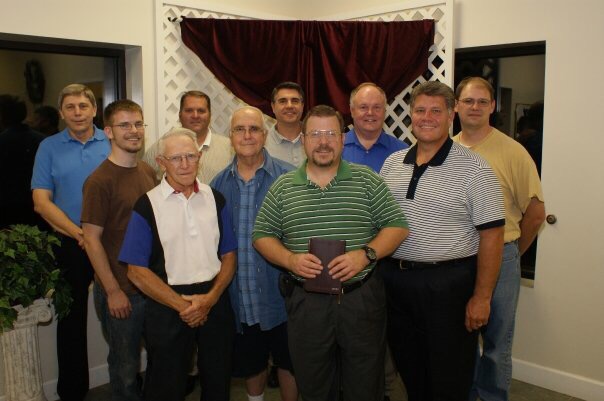
When I think of ministry and ministers, I think of this group of men and others like them. I have had the privilege of associating with these men during my 42 years of ministry and especially this group for the past decade. These men represent what great ministry is all about. Each one has his own unique personality, abilities and gifts, but there is one common quality I want to mention that they share. It is a rare quality and one that unfortunately has grown rarer in the past few years. (I am intentionally refusing to make any comments about the guy with the green-striped shirt in the middle) 🙂

When I think of successful pastors with successful ministries, I think of these men. It is not because their ministries meet the current standards in measuring successful ministry. They do not have a large following or large ministries. They have not written best-selling books on ministry nor have they been published in leading ministry magazines nor have they received media attention for their efforts. They do not have multi-site churches and they may preach to a relatively small group of people. As far as I know, they have not spoken at large conferences (with possibly one exception) or garnered a spotlight on their efforts. They have trudged away in the trenches of ministry day after day for a combined 350+ years, tirelessly seeking to carry out the calling God has placed on their lives. Some have done so with significant personal challenges: fighting health issues, bi-vocational work demands, and the never ending needs of their congregations. They have done so with grace, diligence, and a singular resolve to finish the course set before them. They are among my heroes of the faith along with those mentioned in Hebrews 11. Yes, I put them right up there with those saints of old.

What common quality makes them stand out? They each exhibit that rare quality of FAITHFULNESS.

In 1 Corinthians 4 the Apostle Paul tells his followers how to think of him and how to evaluate him. He is a minister (a slave) of Christ and a steward (manager) of the mysteries of God. Ministers are not CELEBRITIES! They should not be self-seeking, self-centered, or self-promoting. They are simply servants, called to serve Christ by serving His people.

Jesus reminds us: “So you also, when you have done everything you were told to do, should say, ‘We are unworthy servants; we have only done our duty.’” – Luke 17:10

The requirement is “that a man be found faithful.” And we will be evaluated by God, not by others or by ourselves. Others do not see the sleepless nights praying over some person with a serious need. Others do not see the sacrificial service or the anonymous giving. Others do not carry the weight of hurting people or spiritual concern, the weight of feeling the responsibility for the spiritual welfare of their people. We cannot even make a true evaluation of ourselves and our ministry. Many times we have served, thinking that we failed in our efforts, but are unaware of the real impact that service has made. Sometimes we may have felt that we were fairly successful in our efforts, but were blind to the ineffectiveness of that service and the pride that generated it. Ministry is not about having our names in lights or large congregations filling our churches. Ministry is about serving Christ by serving others. It is often ignored, unappreciated, and scorned by others. Only God knows what we have done for Him, how we have served, why we have served and the extent of our labor for Him. And only He can properly evaluate our ministry.

So, what is FAITHFULNESS?

  • It is doing the same thing over and over, day after day, year after year, not because it is always rewarding, fulfilling, and exciting, BUT because it is important, necessary and right.
  • It is doing what is needed, indeed what Christ expects, whether or not it is well-received, popular, or rewarded. We choose to obey God rather than men.
  • It is doing what is right, no matter the consequences.It is serving, because we are called to serve, not because we are paid to serve.
  • It is serving, not because people appreciate it, but because God expects it.

I am not God and I cannot evaluate the ministry of the group of men pictured above. I am not saying that they are flawless or perfect. But I can say that I have observed the quality of FAITHFULNESS in each of their lives and I applaud it!

Posted in Musings from the Manse | 1 Comment